Search Plugin
Authorized discovery across optional public content providers
Best for
Teams adding shared content discovery to an existing React application.
Search public content across the capabilities installed in your application.
BTST supplies
- Request-authorized discovery across explicitly registered providers
- SSR-aware search results and an embeddable source-scoped dialog
- Optional Blog, CMS, School, Ecommerce, and application providers
You supply
- Source providers and their authorization policy
- The application shell and deployment
You own and customize
Your application registers source providers. Each source keeps its authorization and publication rules.
Compatibility and dependencies
Maintained: Next.js 15+ App Router, React Router v7, TanStack Start.
Requires: A BTST database adapter.
External services: None required.
From registration to result
A semantic workflow, not a setup shortcut
- 1Register sources
Choose optional content providers or supply an application provider.
- 2Find content
Use the shared results page or a source-scoped search dialog.
- 3Open a result
Navigate to the source through the application router.
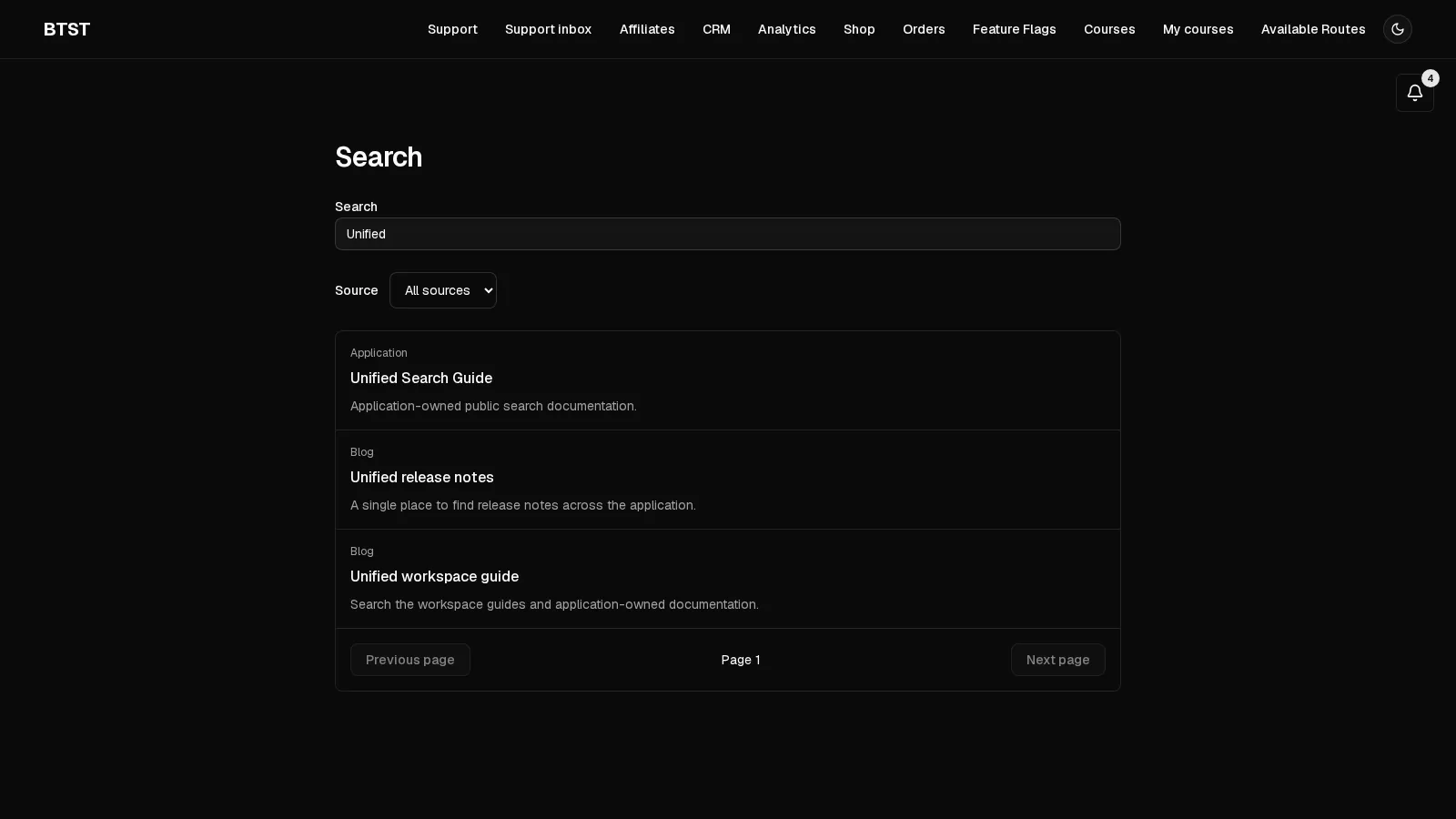
Search adds a /search?q=... results route and an embeddable discovery dialog.
Install @btst/plugin-search@1.0.0 with the current Core. Search has no runtime
dependency on Blog, CMS, School, Ecommerce, or a hosted search service.
Installation
Select search in btst init, or pass --plugins search,blog. The Next.js,
React Router, and TanStack Start scaffolds register Search on both stacks and
import @btst/plugin-search/css. Selecting Blog, School, or Ecommerce alongside
Search adds its optional provider. CMS content types always require explicit
application configuration.
import { createBackendStack } from "@btst/stack/api"
import { searchBackendPlugin } from "@btst/plugin-search/api"
import { blogBackendPlugin } from "@btst/plugin-blog/api"
import {
  blogSearchProvider,
  type BlogSearchOperations,
} from "@btst/plugin-search/providers"

export const myStack = createBackendStack({
  basePath: "/api/data",
  adapter,
  auth: serverAuth,
  plugins: {
    blog: blogBackendPlugin(),
    search: searchBackendPlugin({
      providers: [blogSearchProvider({
        operations: (request): BlogSearchOperations =>
          myStack.forRequest(request).operations.blog,
      })],
    }),
  },
})
The provider resolver runs when a query arrives. Its return type annotation
avoids circular inference when referring to the stack being initialized.
Register searchClientPlugin under the canonical search key on the client
stack. Configure the shared API origin, page prefix, QueryClient, router, and
auth provider using the framework installation guide.
Authorization
Include searchPermissions from @btst/plugin-search/permissions in the
application's defineAuthorization contract. search.query.read receives the
validated source IDs as permission facts. Grant it only for sources the caller
may query. Every source must also authorize its own operation before returning
records, snippets, or continuation metadata.
The built-in adapters call request-bound source operations using the original
Request. Blog uses published post queries, School uses the public course
catalog, and Ecommerce uses its public product projection. Draft posts,
unpublished courses, private lessons, and nonpublic products do not participate.
Do not replace request-bound operations with trusted or raw getters.
Client query parameters cannot supply identity or grant source permissions.
Shared discovery UI and Blog migration
import { SearchInput, SearchDialog } from "@btst/plugin-search/client/components"

// Cross-plugin discovery over the registered sources.
<SearchInput />

// Fixed-source discovery; URL source filters cannot widen this scope.
<SearchInput sources={["blog"]} buttonText="Search Posts" />
SearchInput accepts className, triggerClassName, placeholder,
buttonText, and emptyMessage. SearchDialog supports controlled embedding.
Both use the same resources and query keys as the results route. The route
supports query/source URL state and bounded pagination; keyboard controls,
loading, errors, and empty results are part of the shared UI. Result navigation
uses the configured application router.
Blog's built-in standalone dialog has moved to Search. Applications that use
PostsList or the built-in Blog pages can retain Blog-only discovery with the
optional BlogPluginOverrides.search slot:
<StackProvider
  stack={clientStack}
  router={router}
  overrides={{
    blog: {
      uploadImage,
      search: <SearchInput sources={["blog"]} buttonText="Search Posts" />,
    },
  }}
>
  {children}
</StackProvider>
The CLI adds this slot when both plugins are selected. Blog installed alone
continues publishing, administration, and its domain search operations without
Search. It renders no standalone discovery trigger until the slot is supplied.
The superseded internal shared/search-input, shared/search-modal, and
shared/highlight-text modules are removed; import the supported Search
components entry instead. Blog's public usePostSearch hook remains available
for source-local workflows. Existing School/Ecommerce catalog filters, CMS and
Form Builder management search, relationship selectors, and other feature-local
controls retain their own behavior and do not require Search.
Providers
A SearchProvider has a stable id, a label, and an asynchronous search
callback. The callback receives validated q, bounded limit, the original
request, and the resolved identity. Return already-authorized records with
resourceId, title, a plain-text snippet, and an application-relative
href, plus hasMore. Never use a client source ID to dynamically import code
or call an arbitrary URL.
import type { SearchProvider } from "@btst/plugin-search/types"

const documents: SearchProvider = {
  id: "documents",
  label: "Documents",
  async search({ q, limit, request, identity }) {
    return findPublicDocuments({ q, limit, request, identity })
  },
}blogSearchProvider, schoolSearchProvider, and ecommerceSearchProvider
accept a request-bound operations resolver and an optional destination
basePath. Default mounts are /pages/blog, /pages/learn, and
/pages/shop/products. Set these when the application mounts source pages
elsewhere. Blog search titles are limited to 500 characters. A Blog post whose
complete encoded destination exceeds 2,000 characters is omitted from Search;
truncated reports that projection limit. Included destinations stay exact, and
the original Blog title and slug are unchanged.
Built-in provider snippets process only the first 2,000 UTF-16 code units of the
source text before stripping markup and normalizing whitespace. The resulting
snippet remains limited to 240 code units. Long markup or whitespace prefixes
can leave a shorter or empty snippet; source matching and stored content are
unchanged. The exported searchSnippet helper uses the same bounds.
cmsSearchProvider({ typeSlug, label, search }) requires an explicit public
projection callback. No CMS content type is searched automatically. Do not pass
a generic table getter for a domain-owned type: publication, expiry, ownership,
and other domain rules belong in that domain's public projection. The adapter
rejects reserved domain content-type prefixes; this is an additional guard, not
a replacement for the application's visibility policy. Job Board is not a v1
provider. Private Helpdesk, CRM, and AI Chat federation is outside this release.
Limits, ordering, and errors
GET /api/data/search and myStack.forRequest(request).operations.search.search
share the same validated operation. Inputs are q, optional comma-separated
sources, page (1–10), and limit (1–20). Query text is trimmed and limited
to 200 characters. Blank text returns no records without scanning providers.
At most eight explicitly registered sources can run per query.
Providers return at most 201 candidates each. Search exposes a bounded window
of 200 records, ordered by source ID and then resource ID, with up to ten pages.
There is no global relevance score or exact global total. Duplicate resource
IDs within a source collapse to the first record; identical IDs in different
sources remain distinct through their sourceId:resourceId key. Pagination is
recomputed per request, so concurrent source edits can change later pages.
truncated indicates that more candidates exist beyond the window; it is not
an exact count.
A provider failure or invalid result fails the query with
SEARCH_PROVIDER_FAILED (HTTP 502), so unavailable sources do not masquerade
as complete empty results. Unknown source filters are rejected.
These bounds constrain fan-out, returned candidates, and response size. Existing source operations can scan more records internally to perform text matching; Search does not make those scans indexed or constant-time. Use suitable database indexes or an application provider for larger collections. External indexes, background indexing, embeddings, and AI answers are separate follow-up work.
SSR and cache identity
The generated request-aware routes forward query parameters and credential
headers into a fresh server client stack. searchClientPlugin({ searchParams, identityPartition }) lets manual integrations supply the same values. Keep the
browser stack free of forwarded server credentials. The page and dialog share
resource definitions from @btst/plugin-search/query-keys and hooks from
@btst/plugin-search/client/hooks.
When source results can vary by identity, provide the current identity partition and clear cached data when identity changes. Use the shared StackProvider auth lifecycle; do not reuse one personalized server QueryClient across requests. Do not statically generate personalized search results.
Ejecting the UI
Install the btst-search item from the shadcn registry to
customize the view layer. Data hooks stay in the Search package. Use the client
plugin's page override API to replace the results view.